
Politecnico di Milano (PoliMi), founded in 1863, is an Italian university specialising in engineering, architecture, and design. It is known for its academic rigour and research contributions in these fields. The university encourages collaboration with industry and international entities, enhancing its educational and research programmes.
The Polymer Engineering Lab, part of the Department of Chemistry, Materials, and Chemical Engineering “Giulio Natta,” focuses on the study of structural properties of polymers and composites for highly demanding applications, particularly in terms of reliability, durability, and sustainability. The lab is equipped to analyse thermo-mechanical properties and prepare samples using various methods. It has expertise in structural polymers, composites, elastomers, foams, and adhesives.
The lab’s research is driven by both radical and incremental innovation in compounding, manufacturing and characterisation of new materials for practical applications. The activity focuses on processing, microstructure-property relationships, and numerical modelling. The lab collaborates with industry partners across transportation, electronics, and consumer goods sectors.
Equipped for both theoretical and experimental research, the lab has databases, simulation tools, and equipment for material preparation and analysis. Research topics include rheology, viscoelasticity, fracture behaviour, adhesion, tribology, process optimisation, numerical modelling, and dilatometry.
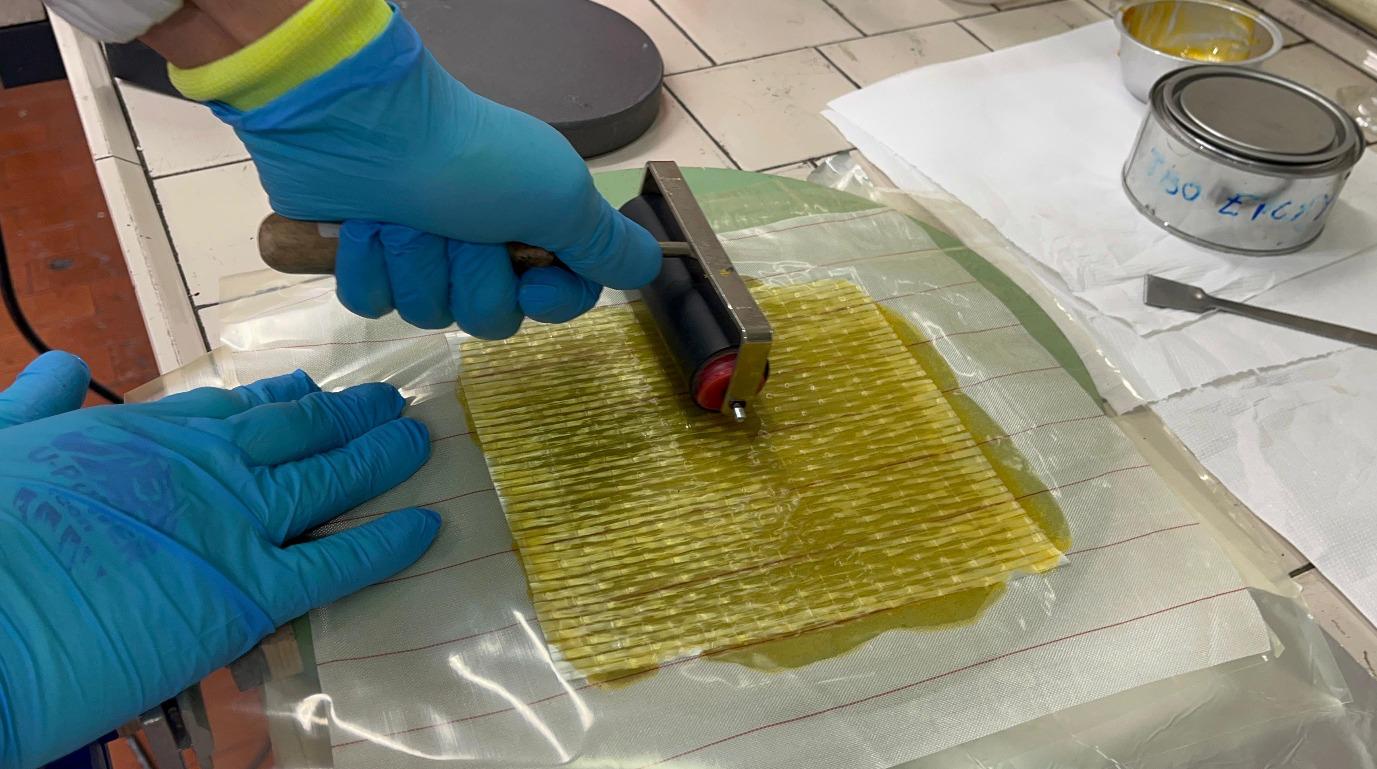
In EOLIAN PoliMi will define the best manufacturing practices for the new composites based on vitrimer resins and basalt fibre reinforcement.
Role in EOLIAN
In EOLIAN, the PolyEngLab at PoliMi will be responsible not only for producing the next generation of sustainable composite materials for wind turbine blades, but also for optimising their recycling.
In terms of constituent materials, the traditional fibres and matrices, namely glass fibre and epoxy resin, will be substituted by basalt fibres and a vitrimeric polymer. PoliMi will define the best manufacturing practices and perform a full performance characterisation campaign.
In terms of recycling, PoliMi will devise the best recycling approaches to minimise the impact of the processes but also to maximise the quality of the outputs.
We spoke to Professor Roberto Frassine and Associate Professor Marco Longana about PoliMi’s work in EOLIAN.
Is PoliMi involved in other projects in the wind energy sector?
Yes, besides the activities conducted at the PolyEngLab, PoliMi is involved in several European projects within the wind energy sector. Apart from its work in EOLIAN, which focuses on recyclable wind turbine blades, PoliMi participates in various initiatives aimed at improving wind turbine efficiency, sustainability, and material innovation. Our colleagues at the POLI-Wind Laboratory conduct research on onshore and offshore wind turbines and Airborne Wind Energy Systems (AWES). Some notable EU funded projects about the topic that were conducted at PoliMi are:
- MERIDIONAL, an EU-funded project working on innovative materials and designs to reduce the Levelized Cost of Energy (LCoE) for wind turbines;
- FLOAWER, which focuses on floating wind energy systems, advancing knowledge in aerodynamics, hydrodynamics, and control strategies;
- FiberEUse, a completed Horizon 2020 project that explored recycling fibre reinforced composites, including wind turbine blades, for circular economy applications.
These projects highlight PoliMi’s commitment to enhancing wind energy technologies, improving sustainability, and fostering innovation in the sector.
What attracted PoliMi to join the EOLIAN project?
For PolyEngLab, joining the EOLIAN project was a natural step in advancing its expertise in polymer engineering and sustainable composite materials. The lab has long been dedicated to developing high-performance, eco-friendly polymer composites, and EOLIAN aligns perfectly with its mission to create repairable and recyclable wind turbine blades.
PolyEngLab’s role in EOLIAN focuses on material characterization, environmental aging, and mechanical recycling of bio-based vitrimer composites reinforced with basalt fibres. These materials offer self-healing properties, meaning they can be repaired in the field through localized heating, reducing waste and extending blade lifespan.
The lab is also working on reshaping processes, allowing repurposing of aged blade materials into new applications, contributing to a circular economy in wind energy.
By participating in EOLIAN, PolyEngLab is pushing the boundaries of sustainable polymer composites, ensuring that future wind turbine blades are more durable, repairable, and recyclable. This project strengthens its position as a leader in advanced materials research while supporting EU sustainability goals.
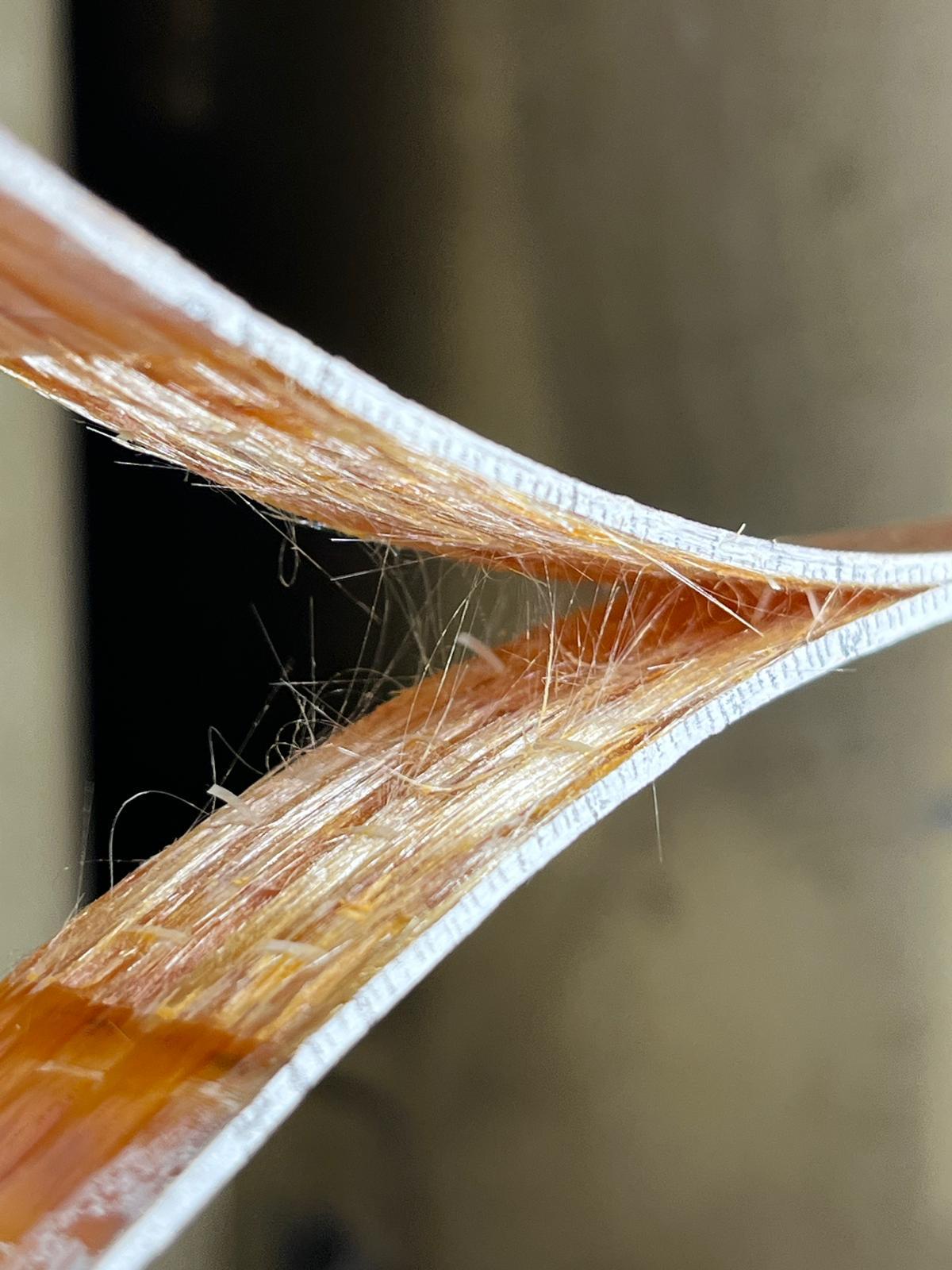
PolyEngLab’s role focuses on material characterization, environmental aging, and mechanical recycling of the vitrimer composites.
Has PoliMi previous experience of working with vitrimers?
Yes, PolyEngLab at Politecnico di Milano has prior experience working with vitrimers, specifically in the context of polymer and composite material research. The lab has conducted studies on vitrimer matrix composites, focusing on their repairability, recyclability, and mechanical performance.
PolyEngLab is also participating in the PLEIADES project, a European initiative aimed at advanced composite materials for aerospace applications, incorporating vitrimeric formulations and photonic sensors to enable smart repair processes.
Furthermore, Prof. Marco Luigi Longana has supervised multiple MSc theses on vitrimer matrix composites, including investigations into fracture repair in woven glass fibre vitrimers and recycling pathways for vitrimer-based structures.
What do you see as the main challenges in developing basalt fibre reinforced vitrimer composites suitable for manufacturing blades?
At the moment one of the main drawbacks of vitrimer matrix composites is their manufacturability: the high viscosity and the short pot-life makes them difficult to handle, especially in the resin infusion process used for manufacturing wind turbine blades. However, the benefits of using vitrimers in such structures clearly outweigh the effort needed to overcome this limitation.
Basalt fibres are ultimately easier to recycle than glass and will allow real circularity also in high volume composite materials.
How will the recycling of these vitrimer composites differ from the composites used in blades today?
Currently the vast majority of wind turbine blades at their end of life are landfilled or incinerated, although co-processing in cement kilns is also possible. This is because a phase separation approach to reclaim glass fibres to be reformatted into a new composite material does not appear to be economically viable, because of the low cost of virgin carbon fibres and the complexity of resizing reclaimed fibres.
Vitrimer matrix composites will be more readily re-introducible into the value chain through simpler reshaping and reworking process, that would retain most of the mechanical properties of the virgin material; or through mechanical recycling processes that do not require phase separation and will produce a recycled material more akin to what the industry is used to.
What do you hope to have achieved by the end of the project?
We would like to have established a clear route for wind turbine blade management that would allow to prolong the useful life of such structures and streamline their reintroduction into the value chain at their end of life.
How will PoliMi use the knowledge gained from EOLIAN?
The expertise gained from EOLIAN will be used to tackle similar problems encountered in other industries, e.g. marine, automotive, and aerospace, and will be transferred to our engineering and design students.
Be in the know
Sign up for our newsletter to receive the latest news from the EOLIAN project