
Complementing the experimental work done by the partners in the other EOLIAN work packages, WP3: Multiscale modelling and characterisation of vitrimer chemistries focuses on modelling the behaviour of the vitrimers and vitrimer composites being developed in the project.
The main goal is to develop a multiscale model to predict the properties of the composite given the vitrimer formulation is known and to create a material card which can be used to perform component or part-level structural analysis.
The main partners involved in this work package are Entelea, which will focus on the molecular-scale models, and Brunel University London (BUL), which will develop the higher-scale FE models.
Daniel Paul from BUL and Kostas Papadopoulos of Entelea provide an update on the work package’s objectives and progress to date.
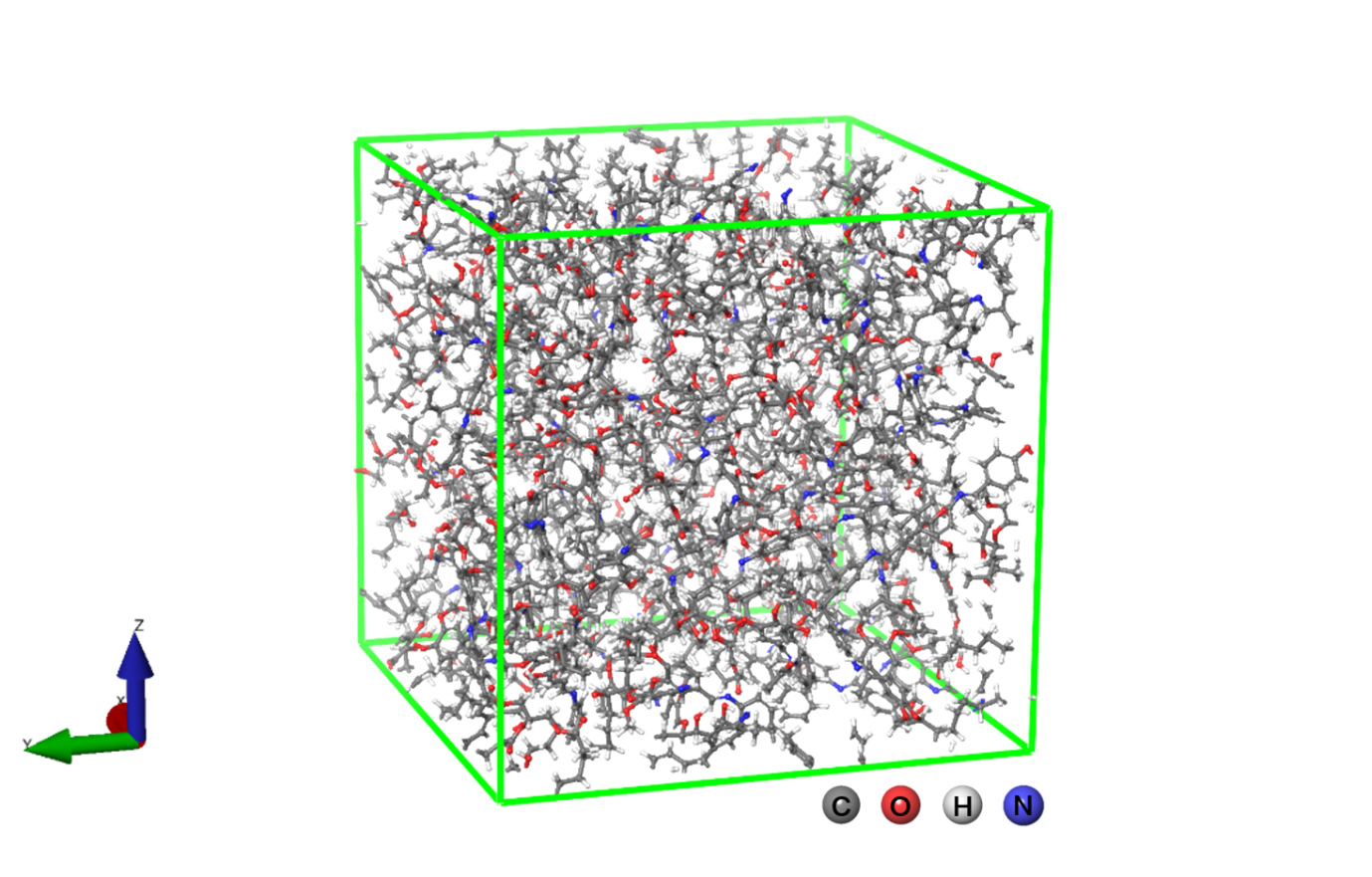
Atomistic representation of an epoxy-vitrimer model equilibrated at room temperature as derived by Molecular Dynamics simulation. (Image © ENTELEA.)
What challenges does this WP address?
Vitrimers and their composites are relatively new to the materials landscape and the understanding of their curing and post-cure behaviour is not yet mature. EOLIAN attempts to address this by developing bio-based repairable and recyclable vitrimer composites with the aim of using them to design and manufacture sustainable wind turbine blades.
Modelling the behaviour of vitrimers using a comprehensive method such as multi-scale modelling provides a better understanding of how lower-scale properties affects the macro-scale behaviour of the material. It also allows for better optimisation of the vitrimer formulation.
What tasks are underway?
The past months have been productive for WP3 with Entelea being able to develop the molecular-scale model of the vanillin-based polyimine vitrimer resins being studied in the consortium.
BUL has been working on developing the higher-scale finite element (FE) models and will use the results obtained from Entelea’s molecular-scale model to create a material card for the vitrimer being studied.
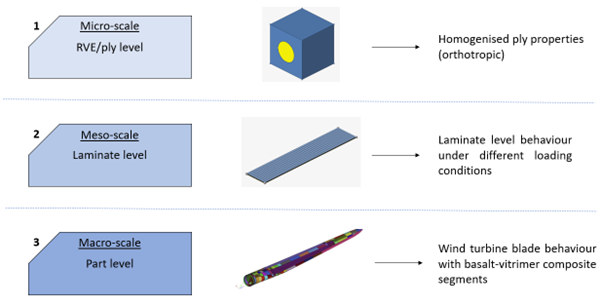
The various higher-level scales studied within EOLIAN using finite element (FE) analysis to obtain the behaviour of vitrimers and their composites. (Image © BUL.)
Progress and next steps
Various useful mechanical, thermal and physical properties of the bulk vitrimer, such as elastic modulus, density, etc., and the vitrimer-fibre interface properties have been obtained from the molecular dynamics model.
These form the basis to perform further higher-scale analysis of macro-scale vitrimer properties.
The next immediate goal is to complete the development of the multiscale model which can then be used to predict the macro-scale behaviour of novel vitrimer formulations, beginning with those studied within the scope of EOLIAN project.
This will also be a useful tool to enable and accelerate the development of new vitrimer formulations which are suited for specific applications.
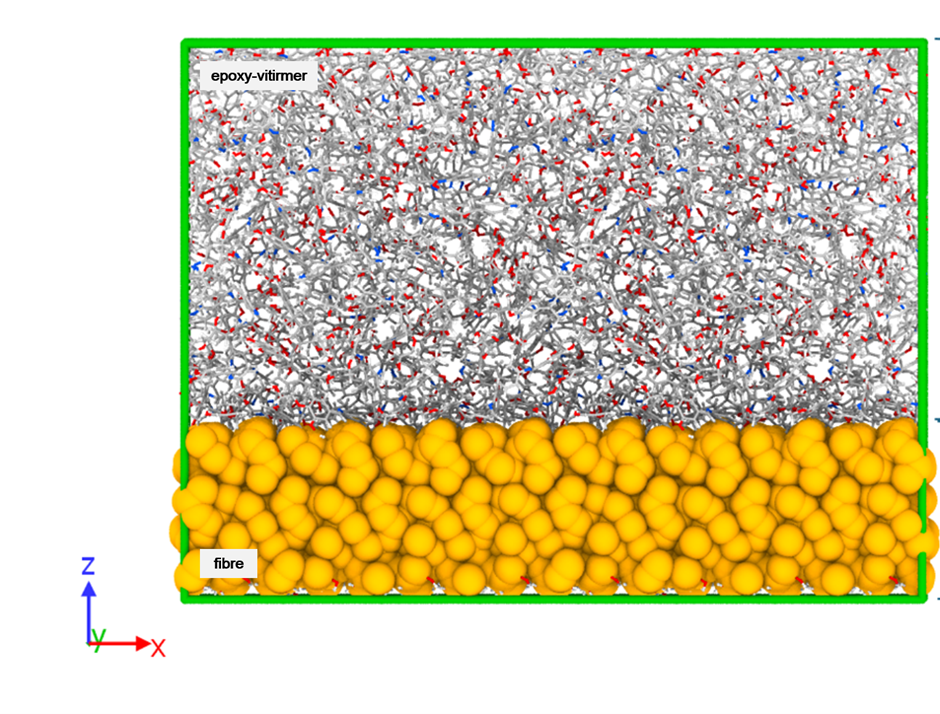
Atomistic representation of an epoxy-vitrimer/fibre interfacial model equilibrated at room temperature, as derived by Molecular Dynamics simulation. (Image © ENTELEA.)
Be in the know
Sign up for our newsletter to receive the latest news from the EOLIAN project