
ECCM22: Brunel University London presents work on multiscale modelling of vitrimer composites
24 June 2026
Brunel University London is presenting the work done as part of EOLIAN Work Package 3, with support from Entelea, at ECCM22 – 22nd European Conference on Composite Materials.
ECCM22 is organised by the Laboratory of Advanced & Sustainable Engineering Materials (ASEMlab) at the Norwegian University of Science & Technology (NTNU). As Europe’s leading conference in composite materials and structures, ECCM is a premier platform for advancing research, fostering innovation, and strengthening collaboration across academia and industry.
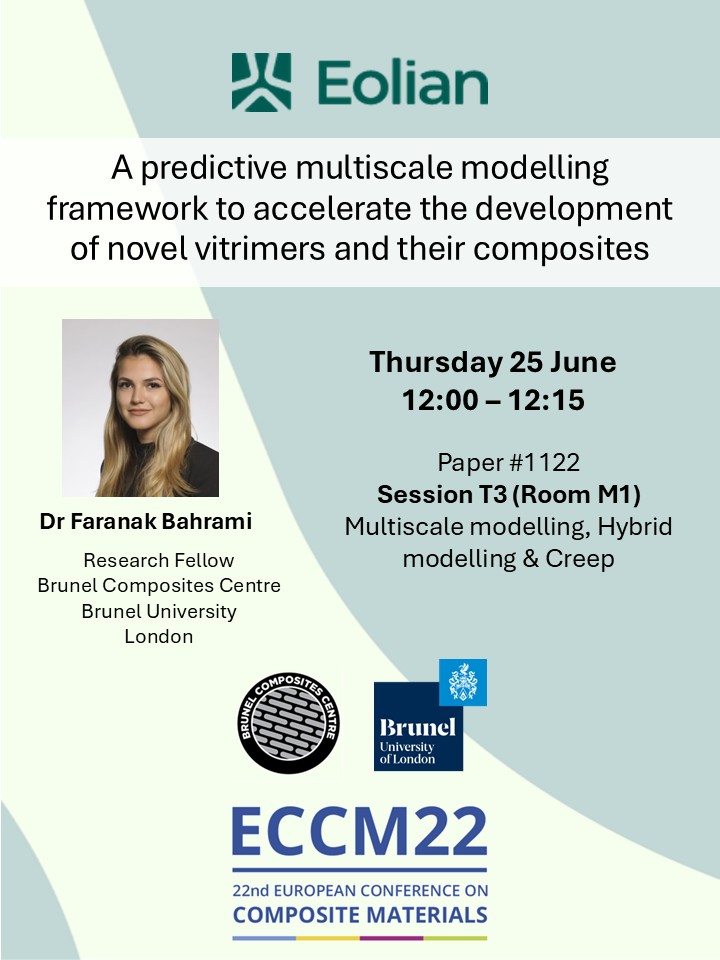
A predictive multiscale modelling framework to accelerate the development of novel vitrimers and their composites
Dr Faranak Bahrami, Research Fellow at Brunel Composite Centre, Brunel University London, will present the work related to the multiscale modelling of vitrimers and their composites on Thursday 25 June at 12:00-12:15.
The presentation will highlight the multiscale modelling workflow being developed as part of the project. The model covers scales from the atomistic to experimental scales (ply, laminate and part levels).
Such a multiscale framework enables the optimisation and acceleration of the discovery of novel vitrimers chemistries and their composites for specific applications without having to develop and test every formulation.
Abstract
There has been increasing interest in the development and scaling up of vitrimers in recent years with several research groups and projects developing formulations with widely different functional groups. Vitrimers are a class of polymers which when used in fibre-reinforced composites promise improved recyclability and repairability due to their unique reversible cross-linking nature. However, it is time-consuming, costly and often unreasonable to synthesise and test every vitrimer formulation studied and considered.
To help speed up the screening and selection process for vitrimers to be used in wind turbine blade manufacturing, the current study, performed as a part of the EOLIAN project, uses a validated multiscale modelling approach to rapidly predict the properties of cured vitrimers with novel chemistries, while minimizing the need for experimentation. The multiscale framework consists of several length scales, including molecular (atomistic-level), micro (ply-level), meso (laminate-level), and macro (part-level) scales.
The vitrimer chemistry is an input to the molecular scale modelling, and the major outputs from the multiscale model are the laminate and part behaviours when subject to different loads. Other inputs to the models are the processing parameters, laminate geometry, and layup configuration. All scales beyond the molecular scale use finite element models to propagate the properties and behaviour of vitrimer composites at the different scales studied. The results of the model are validated, and the model is calibrated using experiments on selected vitrimer and vitrimer composite formulations that have been synthesised.
The proposed multiscale framework is a step towards virtual testing of vitrimers being studied by reducing the time taken in developing novel vitrimers and composites with specific desirable properties.
Be in the know
Sign up for our newsletter to receive the latest news from the EOLIAN project