
ECCM22: Politecnico di Milano presents research on vitrimer composites testing and recycling
17 June 2026
Politecnico di Milano is presenting some of the results of its work in EOLIAN at ECCM22 – 22nd European Conference on Composite Materials.
ECCM22 is organised by the Laboratory of Advanced & Sustainable Engineering Materials (ASEMlab) at the Norwegian University of Science & Technology (NTNU). As Europe’s leading conference in composite materials and structures, ECCM is a premier platform for advancing research, fostering innovation, and strengthening collaboration across academia and industry.
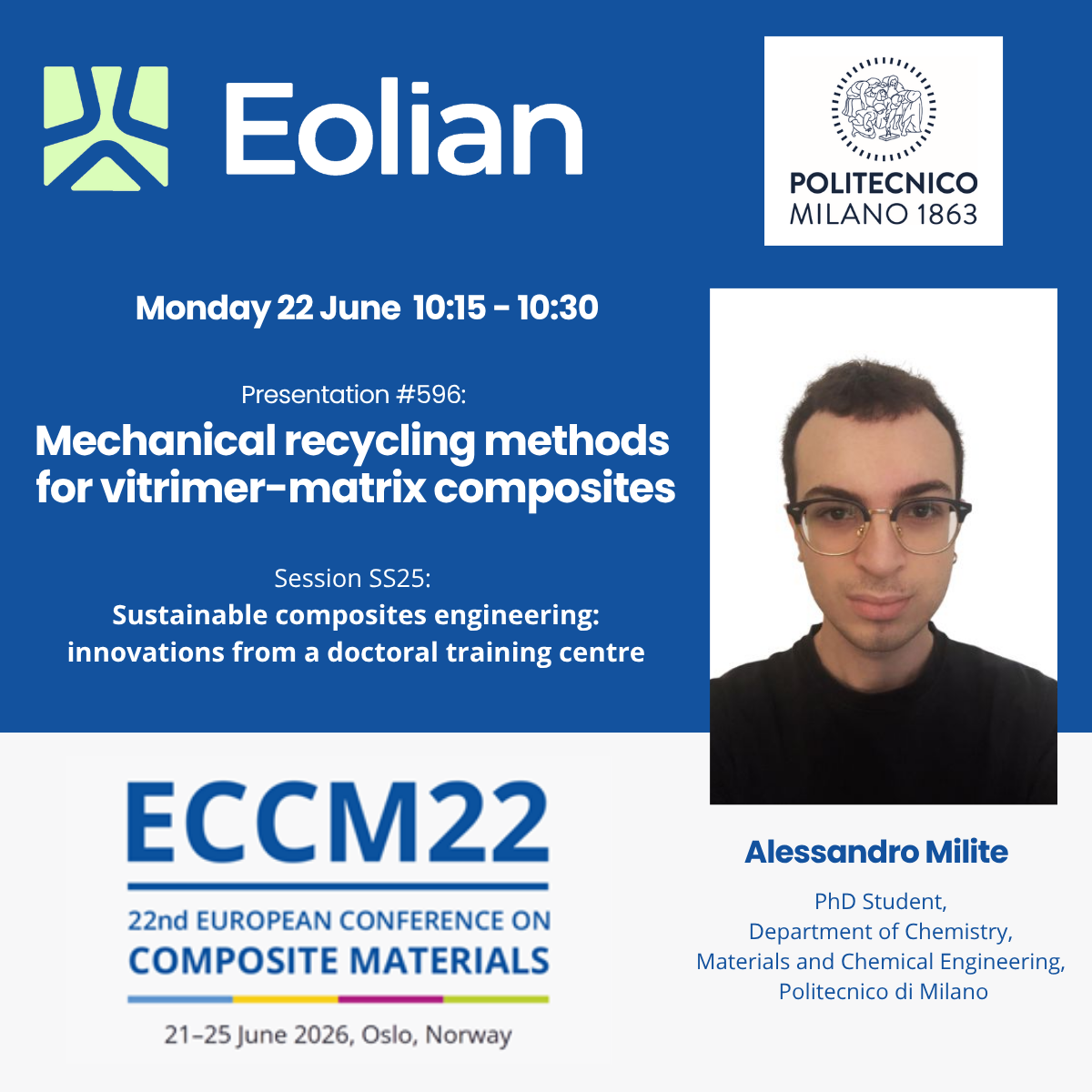
Mechanical recycling methods for vitrimer-matrix composites
On Monday 22 June, at 10:15 -10.30, Alessandro Milite, PhD Student in the Department of Chemistry, Materials and Chemical Engineering at Politecnico di Milano will deliver the presentation #596: Mechanical recycling methods for vitrimer-matrix composites.
This is part of Session SS25: Sustainable composites engineering: innovations from a doctoral training centre.
Abstract
Despite their lightweighting benefits, the sustainability of fibre-reinforced composites might be questionable, since their complex end-of-life management makes their incorporation into a circular economy cumbersome. In the last decade, recycling has gained increasing attention. The established approach for thermoset composites consists of a two-step process: fibres reclamation, performed through thermal or chemical methods; and their reformatting into a new product. Instead, mechanical methods consisting of shredding and grinding cause a substantial downcycling of the material due to extensive fibres length reduction, despite offering many advantages such as reliance on mature technologies and lower energy consumption. For this reason, mechanically recycled composites are used as reinforcing fillers in polymer compounds and cements.
In parallel, the use of new constituent materials represents an active research field: vitrimers, a recent class of polymers characterized by associative covalent adaptable networks, have emerged as attractive alternative matrices. Vitrimers-matrix composites combine the structural performance of thermosets with the reprocessability, repairability, and recyclability of thermoplastics.
In this study, a novel mechanical recycling method exploiting the unique properties of vitrimers is investigated. The use of a vitrimer matrix enables the reprocessing of cured material above the topology freezing temperature, eliminating the need for fibre liberation. Virgin laminates were manufactured using basalt fibres impregnated via vacuum infusion. The laminates were then delayered into their original plies, minimizing fibre damage. The individual plies were subsequently reformatted into either continuous laminates or patch-based architectures. The proposed approach aims to overcome the performance limitations of conventional mechanically recycled composites by preserving fibre length. Both the manufacturability and mechanical performance of the resulting laminates were evaluated, providing evidence of the method’s effectiveness.
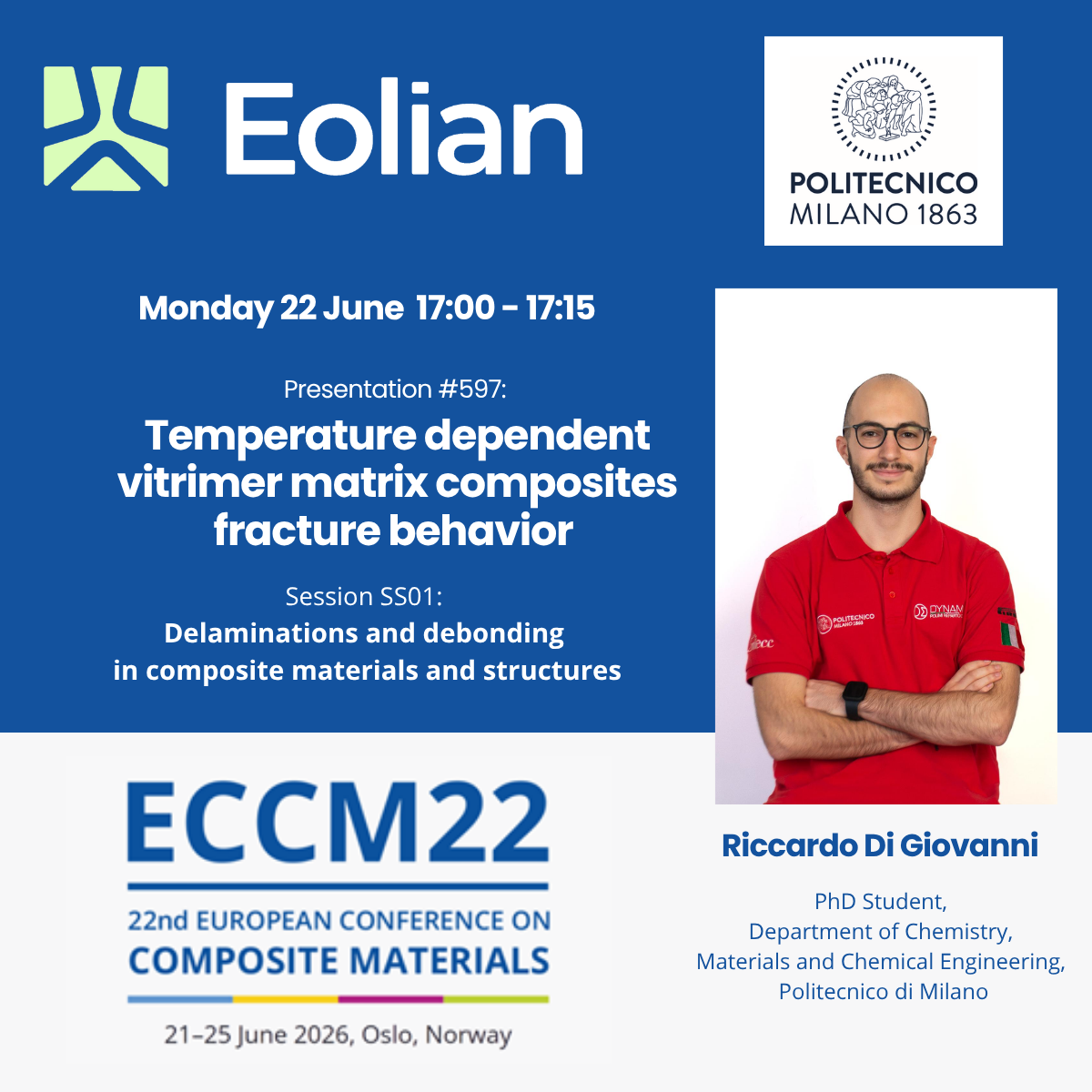
Temperature dependent vitrimer matrix composites fracture behavior
On Monday 22 June at 17:00-17.15, Riccardo Di Giovanni, PhD Student at the Department of Chemistry, Materials and Chemical Engineering, Politecnico di Milano will deliver the presentation #597: Temperature dependent vitrimer matrix composites fracture behavior.
This is part of Session SS01: Delaminations and debonding in composite materials and structures.
Abstract
Vitrimers are polymers bearing dynamic covalent bond within their crosslinked network. By undergoing associative bond exchanges these dynamic crosslinking bonds can rearrange the material topology network rendering it reprocessable and repairable. Using vitrimers as matrices represent the new frontier of circular composite materials since they combine the properties of thermosetting matrices at service temperature, allowing also reprocessing and intrinsic repair of matrix and interface damages. The possibility to extend the useful life of a component by repairing it, or to reprocess and repurpose decommissioned ones, contributes to the mitigation of the increasing waste generated by the composite sector.
Since the reprocessing and healing properties of vitrimers are usually controlled by heat, that increases the bond exchange rate, it is crucial to determine the material behavior approaching and surpassing this activation temperature, i.e. topology freezing temperature (Tv), to fully exploit the possibilities offered by these materials and correctly design the reprocessing and repair processes.
Brunel University London is also giving a presentation during the event. Read more
In this work the effect of temperature on the mechanical and fracture behavior of vitrimer matrix composite is investigated. Thermo-mechanical and stress relaxation tests on the vitrimer resin are used to identify the vitrimer’s characteristic temperatures, i.e. Tg and Tv, and define the reprocessing temperature window. Mechanical tests are used to assess the material properties and their temperature dependence within this interval.
Interlaminar fracture tests are used to investigate the interply properties of the laminate at reprocessing conditions: as temperature increases the fracture toughness of the vitrimer-composite was recorded to increase as the ductile behavior of the matrix was enhanced, leading to larger plastic deformation.
This study contributes to setting the foundation of the use of vitrimer matrix composite for structural application while keeping the focus on their end-of-life management.
EOLIAN partner Brunel University London is also giving a presentation during the event. Read more
Be in the know
Sign up for our newsletter to receive the latest news from the EOLIAN project